Dear Readers,
It is my pleasure to share with you an article written by Msgr. Raymond Kupke, Diocesan Archivist, Pastor Emeritus of St. Anthony of Padua, Hawthorne, Professor of Church History at Immaculate Conception Seminary School of Theology, Seton Hall University, author of the book “Living Stones,” and co-host of the “Coffee with Kupke” podcast.
As you will read in the article, as we look towards the 250th Anniversary of our nation’s Independence, I had asked Msgr. Kupke to consider the most prominent or influential Catholics in the first 250 years of the United States – a daunting and challenging task, but, unsurprisingly, Msgr. Kupke was more than “up to the challenge.” As you read Msgr. Kupke’s thoughts, reflections, and historical perspective, I hope you will have an experience similar to my own, a feeling of being inspired by and of deep gratitude for the women and men whose Catholic Faith, Identity, and Leadership helped to build our country, allowing us to truly be “the land of the free and the home of the brave.” Let us continue to pray that God will continue to Bless and watch over our nation, “God Bless America.”
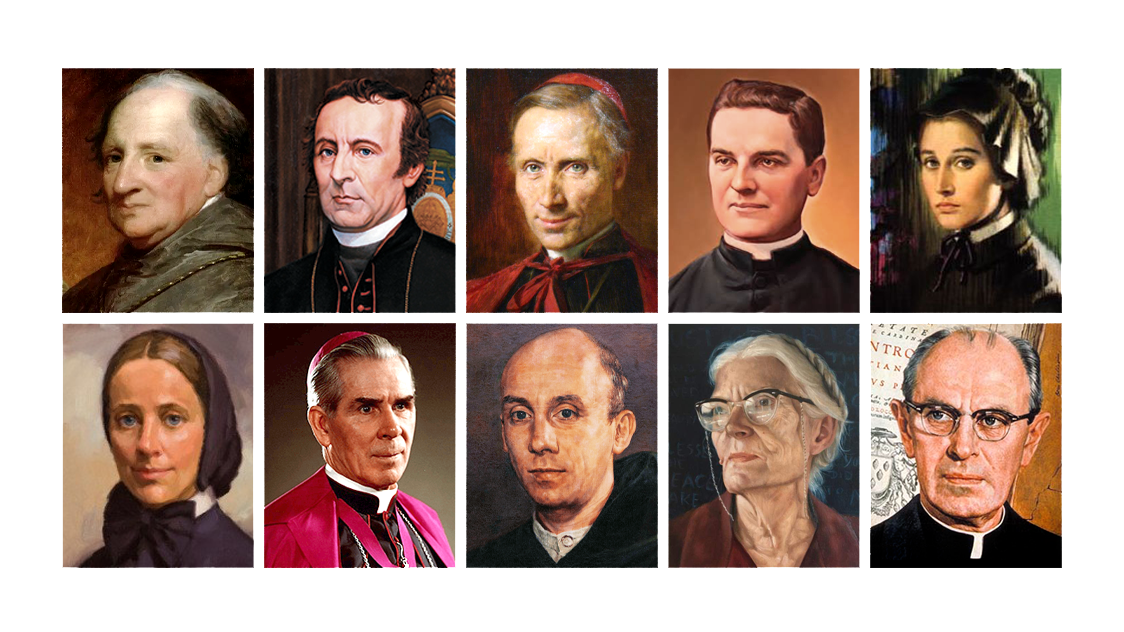
Soon, we will celebrate the 250th anniversary of the American Declaration of Independence. In conjunction with that, Bishop Kevin Sweeney asked me to come up with a list of the 10 most prominent Catholics in America’s 250-year history. It has been a daunting task! I found myself starting out by eliminating whole groups of faithful Catholics. I decided not to include any statesmen/politicians (Al Smith, Joe Biden, Antonin Scalia), or Athletes (Vince Lombardi, Yogi Berra, Katie Ledecky), or entertainment figures (Helen Hayes, Frank Sinatra, John Wayne). I also came to the conclusion that there were two “elephants in the room,” namely the first Catholic President, John F. Kennedy, and the first American Pope, Leo XIV. I eliminated them because their impact is just too far-reaching.
So that left me with a list of four bishops, three priests, two nuns, and one laywoman, three of them converts to Catholicism. In my humble opinion, their impact on American Catholicism stands out.
First, three bishops: Archbishop John Carroll of Baltimore (1735-1815), Archbishop John Hughes of New York (1797-1864), and Cardinal James Gibbons of Baltimore (1834-1921).
Carroll was a native Marylander (his cousin, Charles, is the only Catholic signer of the Declaration of Independence), and in his time he founded both America’s first Catholic college (Georgetown) and its first seminary (Saint Mary’s). He is perhaps the only native son to be the founder of a national hierarchy. (When his diocese was divided in 1808, all four of the new bishops were foreign missionaries). His keen understanding of the American psyche gave him an ability to mediate between Roman expectations and American realities in structuring the Church in our country.
Archbishop Hughes, the first Archbishop of New York, known as “Dagger John,” led and defended his flock during the turbulent years of the Trusteeism issue and the nativist “Know-Nothing” era. His struggles to allow the younger members of his flock the opportunity to study their own faith and not non-Catholic tenets led him to embrace and establish the concept of “parochial” schools that has marked American Catholicism. His understanding of where America was headed led him to select a rural site, then miles beyond the actual city, for the current Saint Patrick’s Cathedral.
Cardinal Gibbons’ life is a list of superlatives. When he was named Vicar Apostolic of North Carolina in 1868, he was the youngest Catholic bishop in the world. Two years later, he was the youngest “father” at Vatican I, and, at his death, was the last surviving father of that ecumenical council. After being made cardinal in 1886, he was, for much of the next 35 years, the only cardinal in the Western Hemisphere. In 1903, he became the first American to vote in a papal conclave. During his time, the Baltimore Archdiocese included Washington, D.C., so he became the unofficial liaison between the bishops and the federal government. He provided moderate effective leadership for the American hierarchy during its most stormy period, the “Americanism” crisis of the 1890s. He skillfully used his own Golden Jubilee as a bishop in 1918 to push his fellow bishops into forming a national bishops’ conference.
Father Michael McGivney (1852-1890) was a Connecticut pastor during the Golden Era of American Fraternalism, when many national fraternal groups flourished. For a variety of reasons, Catholics were excluded from many of these groups, and Catholic men, in particular, experienced career and economic disadvantages from their exclusion. McGivney saw the need for an alternative for Catholic men, and so, in 1882, he founded the Knights of Columbus. It is a tribute to McGivney’s foresight that what started as a fraternal insurance group has successfully reinvented itself to meet the needs of the Church and Catholic men in every era. In particular, the Knights’ rising to the fore on behalf of American Catholicism in World War I, when there was no other national Catholic organization to respond, is to their everlasting credit.
The two religious women on the list, Elizabeth Ann Seton (1774-1821) and Frances Xavier Cabrini (1850-1917), both can claim to be the “first.” When Pope Pius XII canonized Cabrini in 1946, it marked the first time an American citizen had been raised to the honors of the altar. When Pope Paul VI canonized Seton in 1975, it marked the first time a native of the United States had been so honored. She was celebrated on the cover of The New York Times magazine that Sunday as “Saint Elizabeth of New York.” Both were very strong women who could effectively “handle” any man who chose to try to rein them in. As foundresses of religious communities, they worked at opposite ends of the nineteenth century – Seton on behalf of Catholic education and Cabrini as the advocate for the immigrants to the New World. Their canonizations – less than 30 years apart – say something about their impact.
I do not think that the soon-to-be-beatified Archbishop Fulton Sheen (1895-1979), the Trappist contemplative Thomas Merton (1915-1968) and the social activist Dorothy Day (1897-1980) ever thought of themselves as a “team.” But as I look back on American Catholicism in the 20th century, I think they were a very powerful and successful triad. After World War II, the story of American Catholicism changed. The anti-Catholicism present in much of the country was softened by the effects of war. When Jews and Catholics and Protestants were thrown together to fight in the trenches of Europe, there was not much room left over for bigotry. The war and the G.I. Bill changed the futures of many American veterans – Catholic and otherwise.
And onto that brand new stage – with its new medium, television – marched Msgr. Fulton Sheen. He was brilliant, witty, telegenic, and engaging. He had a natural talent for apologetics – and for television. He was the first great “star” produced by the new medium, and each week millions of Americans — Catholic and otherwise — listened in to his program, Life is Worth Living. His intelligible presentation of Catholic teaching had a profound impact on his audience and helped produce many converts. But in case you thought that Catholicism was all doctrine and ceremony, there suddenly appeared these other two converts, Merton and Day, almost flanking Sheen and backing him up. One provided an entrée to the depth and power of Catholic spirituality, especially contemplative spirituality. The other, with her newspaper and organization both named The Catholic Worker, reminded several generations of Catholics that their faith had a practical, lived dimension. When you finished watching Sheen on Life is Worth Living, then you sat down and started reading the two autobiographies, The Seven Storey Mountain (Merton) and A Long Loneliness (Day) for context and depth and reflection.
The three of them helped reshape American Catholicism in the second half of the twentieth century. I do not think it is too far a stretch to see them as a remote preparation for the elections of the two elephants, President John F. Kennedy and Pope Leo XIV.
My final top 10 choice is the Jesuit Priest and Theologian John Courtney Murray (1904-1967). Although his writings, especially on Church and State, were originally highly suspect in Roman circles, New York Cardinal Francis J. Spellman brought him to Vatican II as his “peritus.” Murray is generally regarded as the ghostwriter of the conciliar “Declaration on Religious Liberty.” He took two centuries of American ecumenical and interfaith experience and put a theological framework around it, making a unique American contribution to the Council and to the Church.
So, after too much thought and hand wringing, those are my top 10. I do not really expect many people to accept them outright. But I hope they will at least provide a starting point for discussion.
I apologize to all the many men and women whose contributions to our faith in our country did not make it on my list. Perhaps it will calm the waters if I mention that one of my own fantasies is to host a small dinner party around the topic “American Catholic Identity,” and invite just six of my favorite “practicing Catholics:” Kobe Bryant, Taylor Caldwell, Stephen Colbert, Nancy Pelosi, Mark Wahlberg, and Andy Warhol.
Click here to subscribe to our weekly newsletter.