“I give thanks to my God always, remembering you in my prayers, as I hear of the love and the faith you have in the Lord Jesus and for all the holy ones, so that your partnership in the faith may become effective in recognizing every good there is in us that leads to Christ.”
(Phil. 1:4–6)
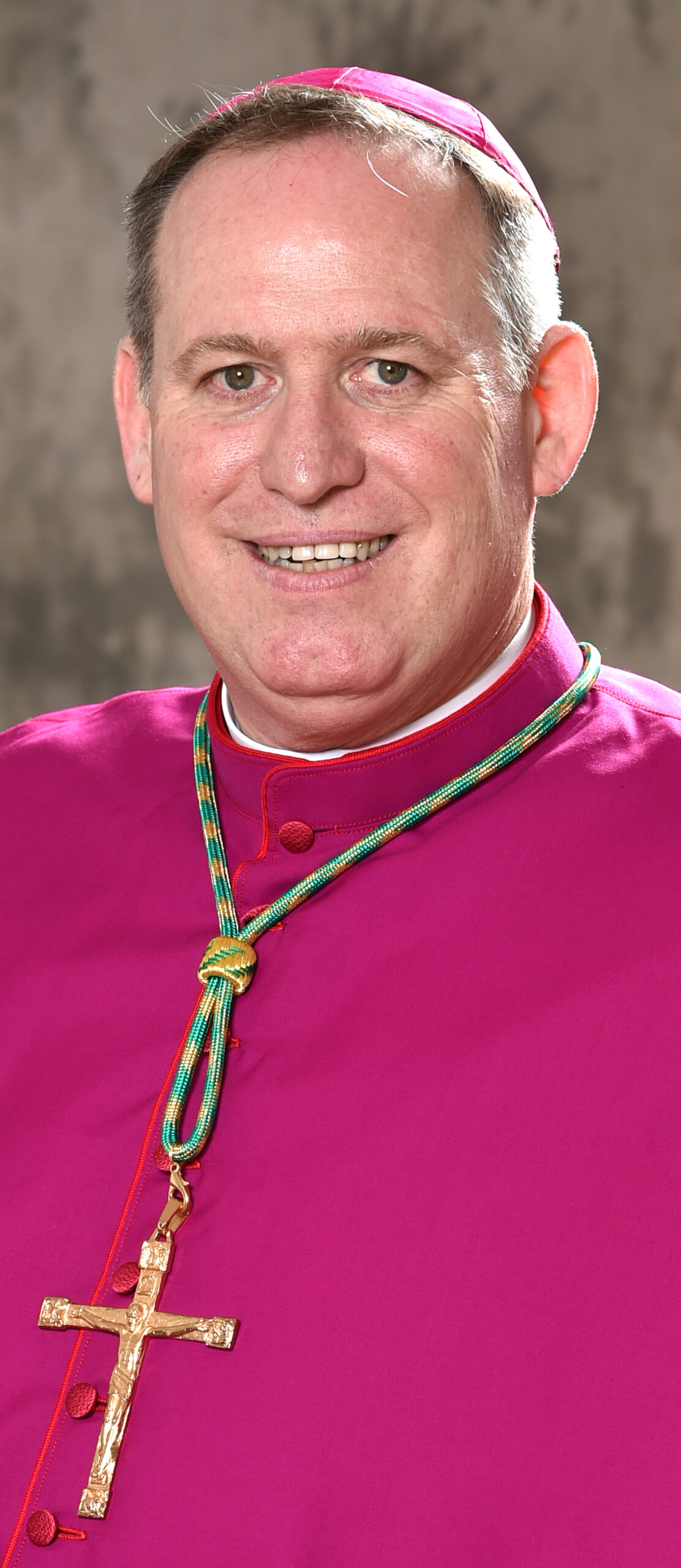
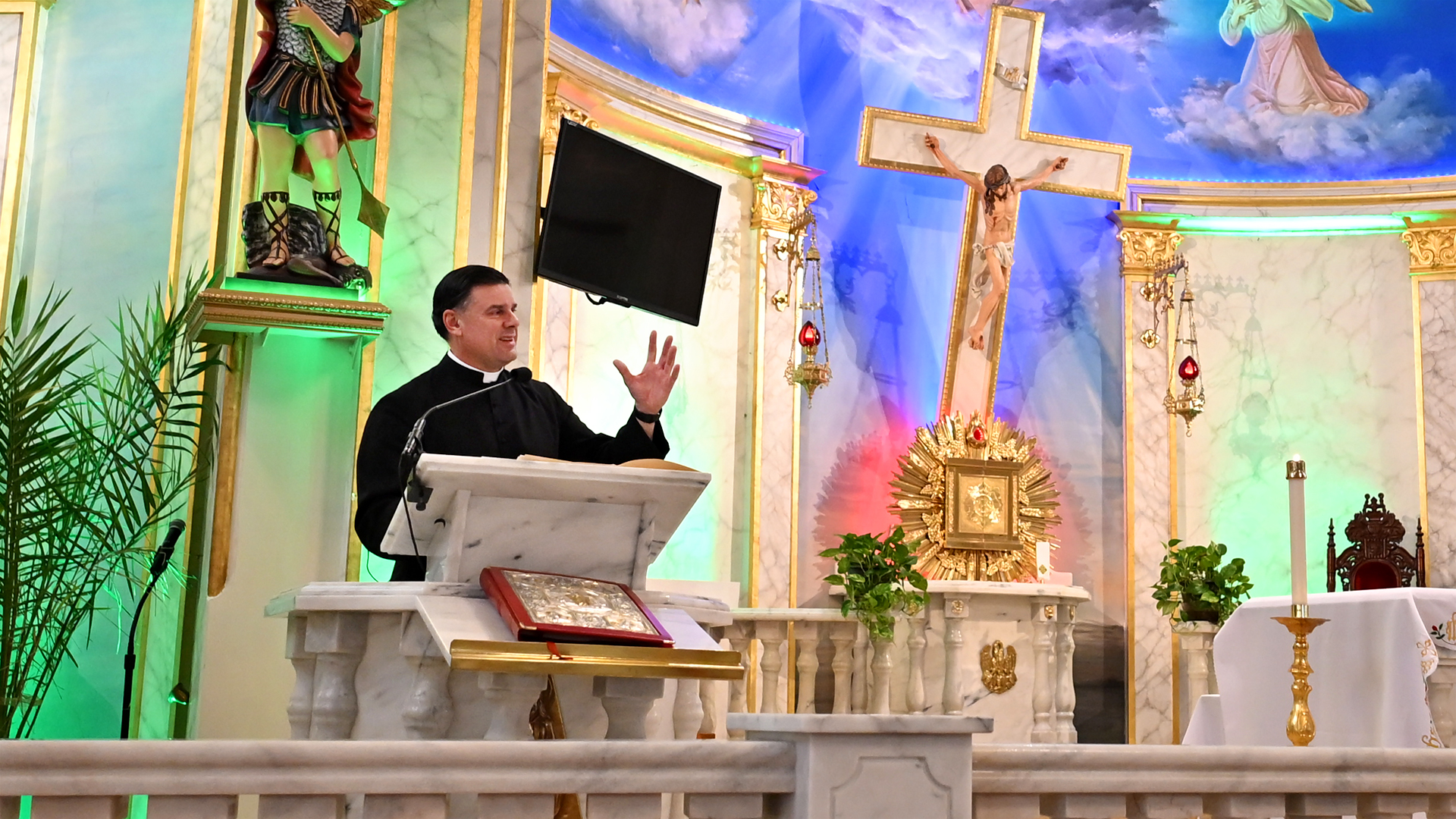
“You can learn something new every day.” You can also re-learn or remember some things that you have learned and forgotten. Among the many highlights of the beautiful (long) weekend from Thursday, June 11 through Monday, June 15, as we celebrated the Solemnity of the Most Sacred Heart of Jesus, followed by ordinations to the priesthood on the Feast of the Immaculate Heart of Mary, and hosting the National Eucharistic Pilgrimage, I had the blessing to hear a talk given by one of the visiting “Eucharistic Preachers”, Father Rafael Capo.
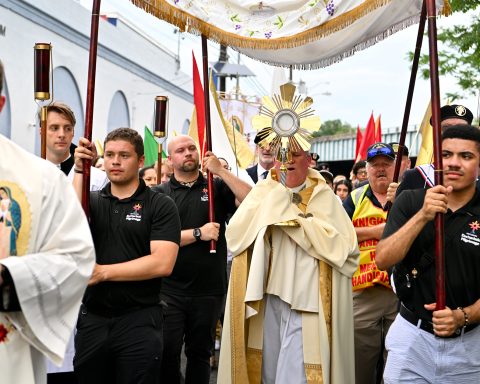
Father Rafael spoke at Holy Rosary Church and the Diocesan Shrine of St. Pope John Paul II in Passaic on Sunday, June 14, in the afternoon, in preparation for a (3-mile) Eucharistic procession through the streets of Passaic, leading to a beautiful opening Mass, for our participation in the National Eucharistic Pilgrimage, at Boverini Stadium, on a beautiful summer afternoon and evening.
The topic of Father Rafael’s talk was “Influenced by the Eucharist,” during which he used the image of the Church as a “pilgrim people” and presented seven “signposts” or ways in which we can be influenced by the Eucharist. The Eucharistic procession was a living expression of a “pilgrim” people being led by the Real Presence of our Lord in the Blessed Sacrament.
One of the signposts that Father Rafael presented was “the way the Eucharist can influence our vision.” During that part of his talk, Father Rafael asked, “Have you read the shortest book in the Bible?” I think he then asked, “Do you know which is the shortest book in the Bible?” and, as I recall, he looked towards me and said (something like), “I’m sure the bishop knows.” I was relieved when he did not ask me to give the answer, because I was stumped – I couldn’t remember. Father Rafael went on to speak about the ways that Jesus, present in His Word and in the Eucharist, can influence our “vision” and can encourage us to “see” people differently, just as St. Paul encourages Philemon.
Father Rafael said that the shortest book in the Bible is The Letter to Philemon. Although Google’s “AI Overview” (see below) and some other sources would “argue” with Father Rafael, it is clear that “Philemon” is one of the (three) shortest. From Google’s AI: The shortest book in the Bible depends on the language and the criteria you use:
- By word count: 3 John (Third John) is the absolute shortest book, containing only 219 words in its original Greek.
- By verse count: 2 John (Second John) is the shortest, containing only 13 verses (though it has slightly more words than 3 John).
A website called OverviewBible has a very interesting and informative article, with an accompanying (10-minute) YouTube Video on the Shortest (and Longest) Books in the Bible, and offers this list:
Here are the five shortest books of the Bible, beginning with the very shortest. These measurements are by words in the original languages. Each of these books is only one chapter long, and would take you a few minutes to read, tops:
- Third John (219 words)
- Second John (245 words)
- Philemon (335 words)
- Obadiah (440 words)
- Jude (461 words)
See: The 5 shortest books of the Bible
Father Rafael spoke about the ways that Jesus, present in His Word and in the Eucharist, can influence our “vision” and can encourage us to “see” people differently, just as St. Paul encourages Philemon, as a Christian, to “see” and welcome Onesimus, “…no longer as a slave but more than a slave, a brother, beloved especially to me, but even more so to you, as a man and in the Lord…” (Phil. 1:16) ) In writing to Philemon, a personal friend, St. Paul demonstrates that his faith influenced evangelization. St. Paul wrote, “I pray that the sharing of your faith may become even more effective so that you may come to perceive all the blessings we have in Christ” (Phil. 1:6). The Eucharist and the power of God’s word impel our mission to build up God’s Kingdom. The Apostle shows that the power of encouragement strongly influences others to value the gifts that flow from faith, “Your love has given me much joy and encouragement because the hearts of the saints have been refreshed by you, my brother” (1:7). The power of the Eucharist influences and transforms our whole vision of life if we are open to the reminder of St. Augustine. In receiving the Eucharist, we “become what we are,” the Body of Christ.
I am sure that I had learned about the Letter to Philemon when I was in the seminary and, more recently, as I listened to the Bible in a Year, but I was so grateful that Father Rafael “re-introduced” me to this powerful and inspiring (short) Book/Letter. The Catholic Bible Online offers this summary:
“The Letter to Philemon is a short and deeply personal letter that addresses the theme of Christian reconciliation and the radical equality of all believers in Christ. Paul writes to a wealthy Christian to ask for the forgiveness and the acceptance of a runaway slave who has become a brother in the faith. We see the power of the Gospel to transcend social boundaries and to transform relationships from one of ownership to one of mutual love. This book teaches us that in Christ there is a new way of relating to one another that is based on the mercy of the Lord.”
The Bible Project website offers a very interesting description and commentary, both in writing and by means of an excellent (6-minute) “narrated illustration” that provides background on Philemon’s household in Colossae and Paul’s relationship with the “Colossians,” – to whom he wrote a Letter, which is a more well-known part of the New Testament. The Bible Project commentary also provides a very helpful reflection on Paul’s use of the word “partnership” in v. 6, from the Greek word, Koinonia (sharing, mutual participation), which, it says, “…for Paul this experience of koinonia amongst Jesus’ followers is not just an idea that you think about, it is something that you do in your relationships…” I encourage you to take the time to watch and listen to the full narrated illustration.
Even more importantly, I encourage you to take a few minutes to read and pray with St. Paul’s Letter to Philemon. I am a “slow reader,” so I was surprised when, out of curiosity, I used my phone’s “stopwatch” to see how long it would take me to read the letter. 1 minute and 49 seconds! I think I have read and prayed with the Letter about five or six times since Father Rafael brought it back to my attention. If you are like me, you might also take the time to read the (even shorter) Second and Third Letters of John. I hope that, like me, you will be glad you did so. You might also find yourself being reminded that “you can learn (or re-learn) something new every day.”