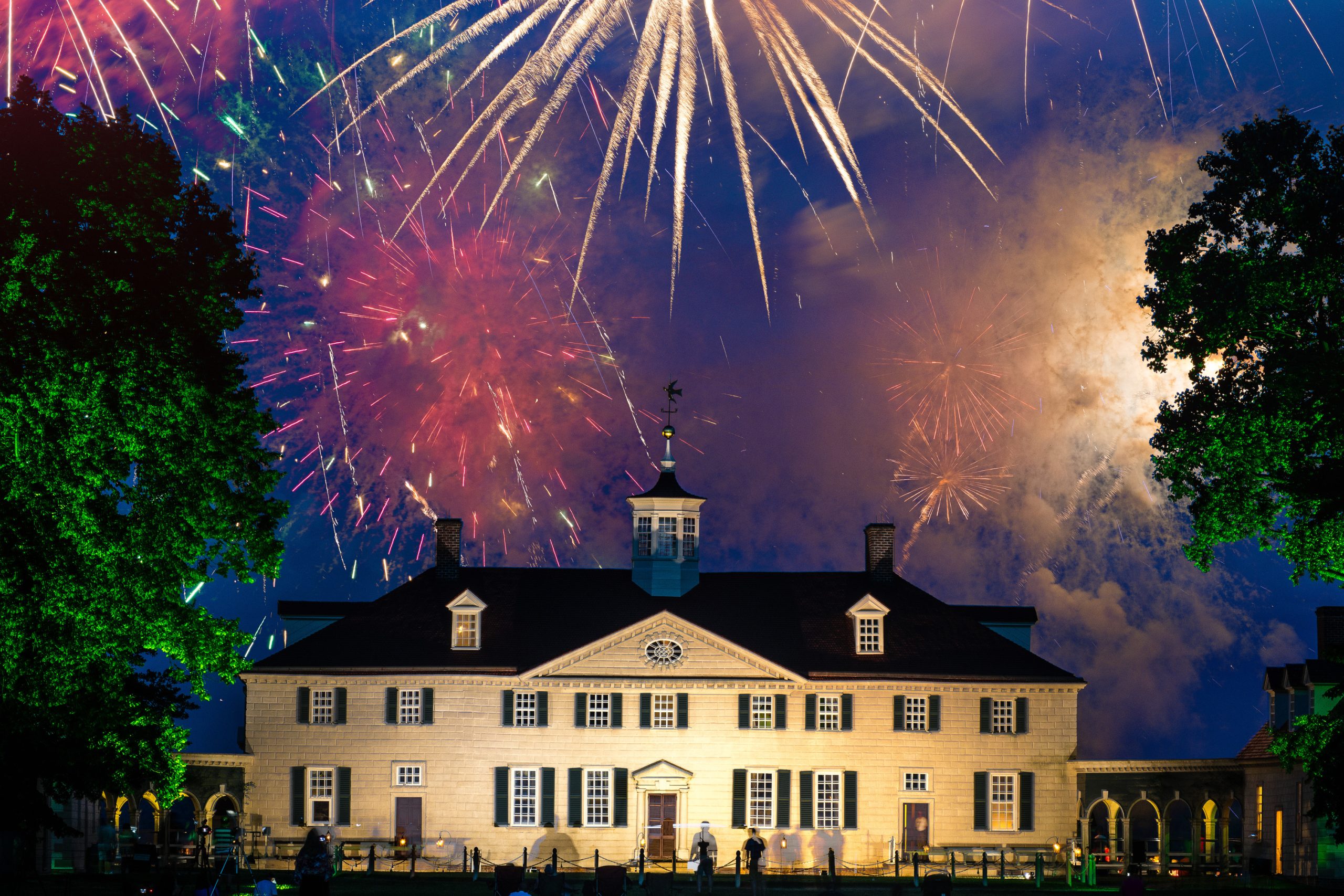
Many of my deepest childhood memories are the timeless ones about family traditions, school events, summer vacations, late 1970s fashions, my cat, and adventures with friends. Along with these, I remember the significant place of the American Bicentennial in my earliest memories.

I remember our family mailbox filled with literature from leaders of our National Parks announcing all the ways in which they would celebrate the nation’s 200th birthday. I recall television shows celebrating this event, and closer to home, an all-grade school pageant with each class focusing on a different decade of American history. (Yes, my suffragette costume is still stored somewhere in my home.) I remember going out to Long Island with my parents and siblings, where the “Freedom Train” was visiting on its national tour, bringing treasures from the Smithsonian Museums cross-country to be widely enjoyed.
I recall stores, restaurants, and gas stations offering commemorative buttons, glasses, and other memorabilia for many months leading up to the big day, while special stamps and coins were issued for collectors. This was not a one-day event! The years leading up to the Bicentennial were filled with reminders of what a remarkable milestone this was.
We are now merely one year from the nation’s 250th anniversary — a quarter of a millennium since the Declaration of Independence was signed, declaring that these United States “are, and of Right ought to be Free and Independent.” Yet, I have heard so very little about this occasion so rapidly approaching and, seemingly, so little noticed.
Click here to subscribe to our weekly newsletter.
I know that there is a formal U.S. Semiquincentennial Commission, a website that announces various state plans, and academic conferences exploring the meaning of this clumsily dubbed “semiquincentennial” year.
Nevertheless, this occasion is not permeating popular culture as it did in my early childhood days. Those who are now the same age as I was in 1976 are unlikely to look back and see this milestone as a defining event in their childhoods.
That saddens me.
Some may argue that these more subdued celebrations are a result of the nation’s political divisions. Yet, the exuberant Bicentennial celebrations came in the aftermath of the turbulent and violent 1960s, the heartbreak of the Vietnam War, and the scandal of Watergate.
Some might argue that this milestone is not worthy of celebration due to moral failings in our history. Yet, with clear eyes and honest hearts, we still have much to celebrate and for which we owe our ancestors a debt of gratitude that we cannot repay, except by bequeathing to those who follow us a union more perfect. In “America the Beautiful,” we sing, “God mend thine every flaw.” This prayer of love can rightly be said for all the imperfect people and institutions we can still cherish and honor.
Some might say it is more important to celebrate all the ways in which we are unique and different rather than emphasize what unites us. Yet, in every loving family, the unique diversity of each member should not conflict with honoring all that unites the family and draws them together. Such should also be true of a nation.
One year remains before we celebrate the 250th anniversary of the land that I love. I hope that in this limited time before July 4, 2026, we can prayerfully consider how we might recapture a taste of the awe I knew in 1976.
I believe the signers of the Declaration of Independence provided us with a roadmap for doing so. They ended their Declaration by promising, “for the support of this Declaration, with a firm reliance on the protection of divine Providence, we mutually pledge to each other our Lives, our Fortunes and our sacred Honor.”
Today, as we prepare to celebrate, reliance on God is for us, as for the signers, our starting point. Thus, prayer for our nation should be the foundation for all our preparations for our semiquincentennial.
Only then may we have the strength to pledge three things to our ancestors, our contemporaries, and the generations who will inherit this nation from us. First, we can pledge to them that our lives will be lived in ways that will continue to build up our nation, not merely in strength but in goodness. Second, we can pledge to them that we will be good stewards of the fortunes — the opportunities, freedoms, natural resources, and so many other treasures — we are blessed to have in our nation. Third, we can pledge to them our sacred honor to preserve, with courage, service, sacrifice, and love, the very best ideals for which our nation was founded so long ago.
It may be too late for the multi-year celebration that punctuated a momentous time in my childhood. But it is not too late to prayerfully enter our nation’s 250th year and celebrate the extraordinary anniversary coming soon to our ordinary time.
Lucia A. Silecchia is Professor of Law and Associate Dean for Faculty Research at the Catholic University of America’s Columbus School of Law. “On Ordinary Times” is a biweekly column reflecting on the ways to find the sacred in the simple. Email her at silecchia@cua.edu.