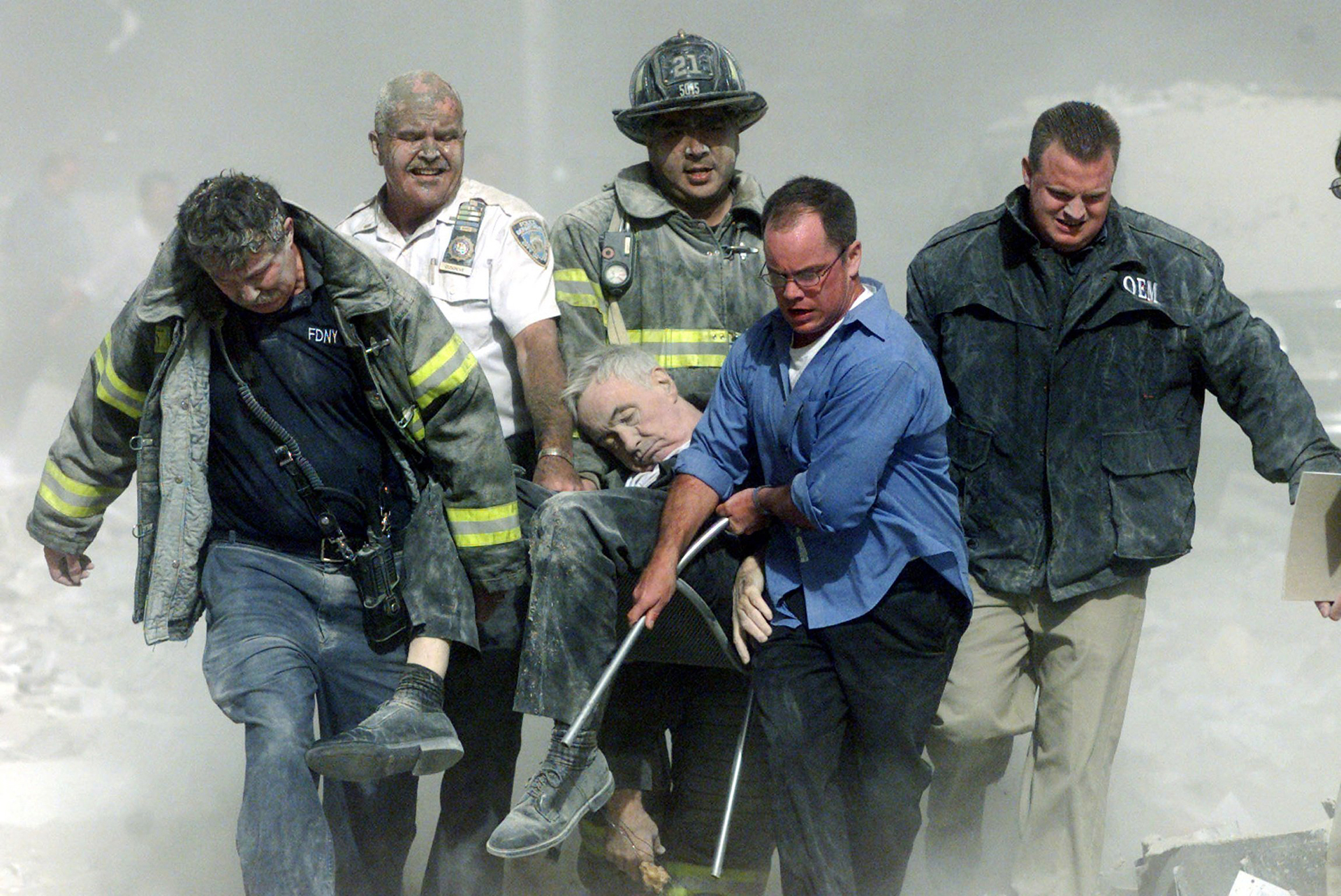
“… the light shines in the darkness, and the darkness has not overcome it.”
(Jn. 1:5)
“… No one has greater love than this, to lay down one’s life for one’s friends.”
(Jn. 15:13
It was a beautiful early September morning. There was a magnificent, clear blue sky. Among the many memories shared by those who lived through the events of Tuesday, Sept. 11, 2001, as we look back, many of us remember the beautiful, clear blue sky … and then we remember hearing (or seeing) that “a plane hit one of the Twin Towers.” Many recall first hearing that it was a “small plane” … then, many of us turned on the television and (soon) saw the “second plane hit.” By that time, many firefighters, police officers, and first responders were on site or were rushing to the location that would come to be known as “Ground Zero.”
There is a detailed timeline of the events that took place one Sept. 11, 2001, that can be found on the website of the University of Virginia’s “Miller Center.” I would think that those who lived through that day would have a similar experience of being amazed at how clear those terrible memories are 25 years later, when recalling the timeline — the first plane hit at 8:46 a.m., the second at 9:03 a.m., the first (South) Tower collapsed at 9:59 a.m., the North Tower collapsed at 10:28 a.m.
In my six years as bishop, I have written and spoken on numerous occasions about my own experiences and memories of “9/11” and the days and weeks that followed the terrorist attacks. I was surprised to hear recently that as much as 30 percent of our country’s current population is not “old enough” to remember that day in 2001:
“Census data and national studies (such as reports from the Pew Research Center) indicate that nearly one-third of the U.S. population (about 31% to 32%) was either born after 2001 or was too young to retain conscious memories of the event.” How the Post-9/11 Generation “Never Forgets”
As I recall that day, perhaps most especially recalling those who lost their lives and those who lost a loved one, I believe that, as many have promised to “Never Forget,” we must remember and learn from the heroes and heroism of that moment in our history. I wonder how many high school (or college) students, teenagers, or young adults are aware of the story of “Flight 93?” In addition to my own personal memories of all that I saw, heard and learned living in New York City and serving as a parish priest on that day and the days, weeks, months, and years that followed, I remember hearing and learning the story of the passengers and crew of “Flight 93” who fought back, inspired by the words, and leadership of Todd Beamer (“Let’s roll”) as they stormed the cockpit and caused the plane to come down in an empty field in Shanksville, Penn.
I continue to wonder how many of our young people are familiar with the images of the firefighters, police officers, and first responders who went into the Twin Towers while thousands were able to evacuate and their lives were saved? Do we remember and share the stories of the countless acts of kindness, courage, and heroism of (so-called) “ordinary people” who helped and stayed with the injured or otherwise impaired people as they tried to escape the towers, some who made it out to safety and so many who “gave their lives” to save the lives of strangers?
I believe that 25 years later, we can still learn and teach important lessons by remembering and telling the stories of the courage, kindness, heroism, and sacrifices of that day, when the “light shone in the darkness,” and the darkness did not overcome it. It is important and valuable to remind ourselves and remind others that we should ask the question, “Where did those heroes come from?” and “How were they prepared to ‘step up,’ remain calm, reassure, and lead others?” Surely some were prepared because that is what they had been trained to do in the Police or Fire Academy, some who were only a few days or weeks “on the job” on that day and some who were ready to retire, who’s many years of experience allowed them to lead others and save countless lives.
Whether it was firefighters, police officers, and other first responders or the “ordinary civilians” whom we remember as the heroes of Sept. 11, 2001, we should also remember and recognize their parents and grandparents, teachers and coaches, priests, religious and catechists, their parishes and communities of faith that formed, inspired and taught those heroes from their earliest years. Many of those heroes were raised in Catholic families, and educated in Catholic schools and parish religious education programs and were taught to love God, and love our neighbor and to love others as Jesus loves us. They also learned what it meant to be strengthened by the sacraments and guided by asking God’s help through daily prayer.
Those who lived through that day and the days, weeks, and months that followed probably also remember the experience of how close we felt to one another, no matter where you came from or what language you spoke, we were neighbors and we were united; united in grief, but united in our resolve and concern for one another. New Yorkers were united as a city; towns and cities all across the United States shared a special solidarity with one another, and particularly with New York, Washington, D.C., and Shanksville. We were united in our gratitude, especially for the heroes of that day and for all who served us in uniform. We were united in prayer; churches were filled for funerals and memorial Masses, but also for Sunday and daily Masses. Many are saddened because, 25 years later, we have lost much of that unity (and gratitude?).
If we remember and if we continue to learn the lessons taught to us by the Heroes of Sept. 11, 2001, I believe we can be stronger, kinder, more united, grateful, and prayerful as individuals and families, as communities, as a nation, and as a Church.
Click here to subscribe to our weekly newsletter.