
“When the Eternal Breaks Through” is the title given to Bishop Robert Barron’s homily for the Second Sunday of Lent. You can watch or listen to the homily here. On this past weekend, the Second Sunday of Lent, we heard and reflected upon the Gospel of the Transfiguration (Lk. 9:28b-36). Bishop Barron says that The Transfiguration “… opens up something … moments when life, when reality becomes incandescent or transparent to something more …” He speaks of moments when “suddenly the light breaks through, as if from another world – something from beyond this world, that can be glimpsed through this world…” I encourage you to take the time (15 minutes) to listen to the whole homily.
As Bishop Barron and many preachers and spiritual writers suggest, the account of the Transfiguration invites us to consider the “Transfiguration Moments” (“when the eternal breaks through”) that we have experienced in our own lives. Having reflected on this Gospel passage, whether it be from Matthew (17:1-8), Mark (9:2-13), or Luke, at least once or twice each year since my years in the seminary as a priest and bishop, I have looked back on a number of significant “Transfiguration Moments” in my own life. As I think about the Transfiguration this year, two (somewhat related) memories or examples come to mind.
This past week, many recalled that it had been five years since the outbreak of the COVID-19 Pandemic and the “lockdown” that we lived through, beginning in mid-March 2020. While I, like many, have many sad memories of the pandemic and lockdown, it was also a time when we relied on our faith and prayer to guide us in the most difficult of circumstances. Perhaps you may have had a “happy moment” or a moment when you felt God’s presence in the midst of the pandemic and lockdown that, as you look back, could be called a “Transfiguration Moment”?
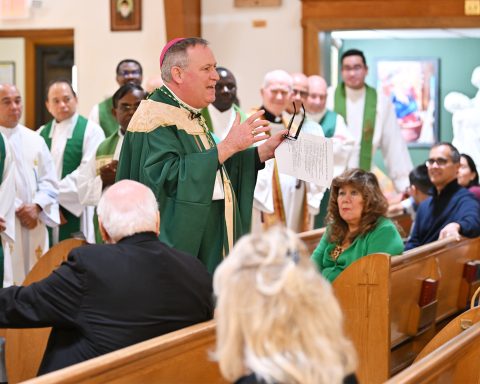
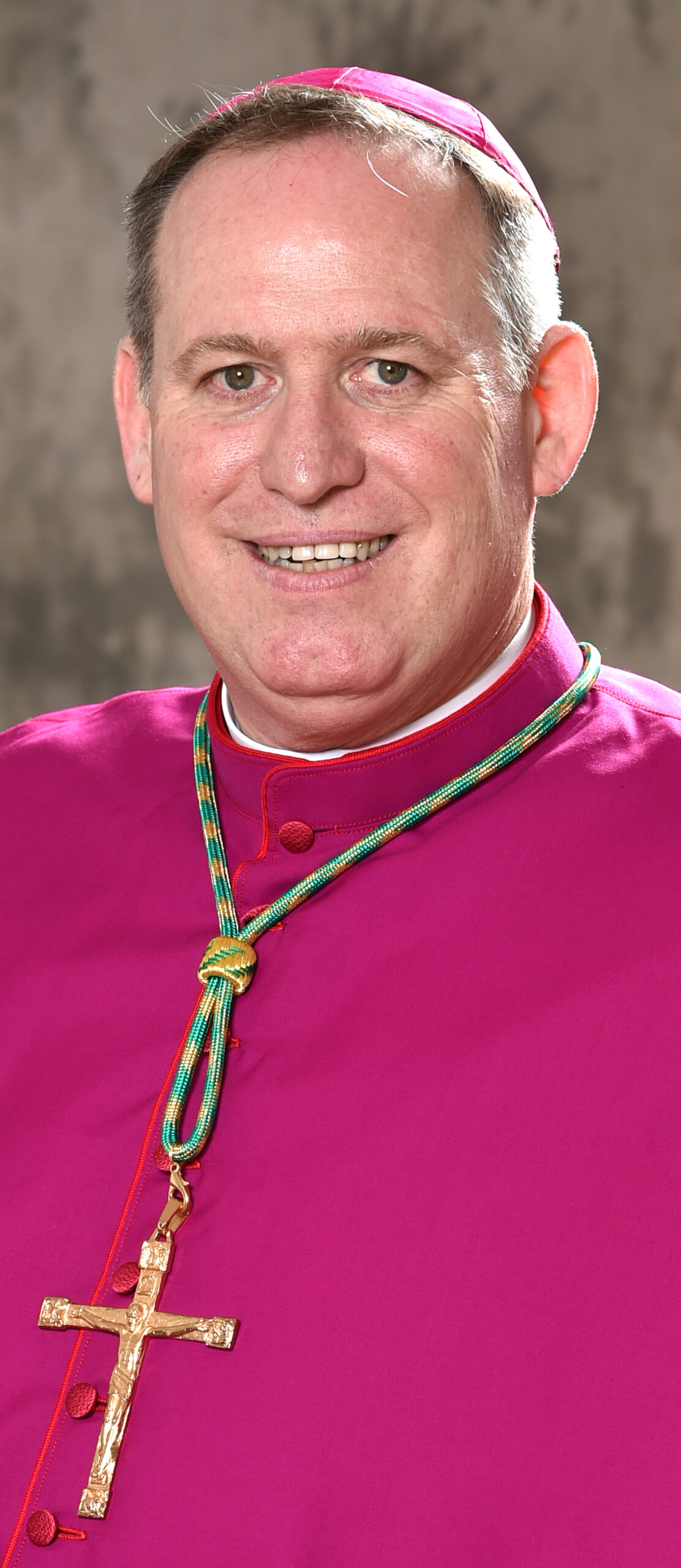
On March 30, 2020, I received a phone call from the Papal Nuncio, telling me that the Holy Father was naming me as the next bishop of Paterson. That phone call led me to be ordained and installed as Bishop on July 1, 2020, ordaining five priests (thanks to Bishop Arthur Serratelli) and two transitional deacons between July and August and 14 permanent deacons on Aug. 22. Those were moments when I experienced the “eternal breaking through.” I hope that many had the same or similar experiences.
We learn from the Gospels that part of the reason why Jesus invited Peter, James, and John “up the mountain to pray,” where they would see him “transfigured” in His glory, accompanied by Moses and Elijah, and hear the voice from the cloud say, “This is my chosen Son; listen to him”; was to prepare them for his suffering and death. In the journey of our lives, especially in this Jubilee Year, reflecting on the call to be “Pilgrims of Hope,” our recollection of and gratitude for moments and experiences of God’s grace and glory can help us to persevere and keep going when the road feels like the Way of the Cross to Calvary.
I would not describe the second source of happy memories (necessarily) as “Transfiguration Moments” because they would usually not be spiritual experiences or moments “when the eternal breaks through,” but I would argue that they are part of our human experience that, for many, can lead us to the sense (or awareness) of the “something more” that Bishop Barron describes. In the first three years of writing this column, somewhere around this time of year, I reflected on some spiritual “lessons” that could be learned from playing or watching sports. I did not write a “sports column” last year, and I had been wondering whether or not I would do so this year. When I began to hear recollections about the start of the pandemic and lockdown, I recalled that one of the much more “minor” inconveniences and challenges of the lockdown for sports fans was that it was a time when (live) sports went “dark.”
Fans of college basketball, especially the Big East and “March Madness,” may recall that on Thursday, March 12, 2020, when four games of the Big East Tournament were scheduled to be played, only the first half of the first game (St. John’s vs. Creighton) was played. All the fans were sent home at halftime, and the rest of the Big East (and NCAA) tournament, like so many other events, was canceled. Although much has changed in college basketball, even over the past five years, and with apologies to Seton Hall fans, for fans (like myself) of St. John’s Red Storm Basketball, it has been wonderful this year to have and look forward to some of our happiest (on court) moments in the past 40 years. This past Saturday night, when St. John’s won the Big East Tournament, was one of those moments.
Spring Training, March Madness, Opening Day, The Masters (golf), and the NBA (for Knicks fans, at the moment) make this a wonderful time of year. I mention all of this for two reasons. First, one of the lessons I learned from the pandemic and lockdown is not to take “happy moments” for granted. Whether those moments are the “more important” life moments when we can gather as families and as communities of faith in prayer and celebration, or the “less significant” but still very enjoyable experiences of playing in, attending, or watching a basketball, baseball game, other sporting or social “event.”
The other connection that I see between the experience of the pandemic and lockdown and the experiences of athletes and sports fans that can give us some insight into our spiritual lives is something that sports fans and others refer to as “mental toughness” and in the spiritual life is called “perseverance.” When you study great athletes in almost any sport, both individual and team sports, they all have the ability to focus, dedicating themselves to hard work, sacrifice, and training that prepares them to be able to perform at their best at the most important and crucial moments. That same quality of “mental toughness” also gives them the ability to inspire others, especially their teammates, and often manifests itself in a “never say die” or “never give up” quality and belief that they can persevere and win, even when all seems lost. During the pandemic, I saw many leaders and heroes in the Church and society, especially doctors, nurses, first responders, and front-line workers, who displayed great “mental toughness” and perseverance in the most challenging of real-life circumstances.
Jesus knows that it is not always easy for us to persevere in prayer and in our spiritual lives. He blesses us with “happy moments” in our lives and moments of grace “when the external breaks through.” It is important for us to remember and give thanks for those moments. Another lesson of the Transfiguration is that we cannot “stay on the mountain top,” as Peter proposed to do by building three tents. While it is important for us to remember and give thanks for the “Transfiguration Moments,” we also realize that Jesus calls us to stay with Him as He goes down the mountain, inviting us to “deny ourselves, take up our Cross, and follow (Him)” (Mt. 16:24).
Image: Altus Fine Art | Simon Dewey