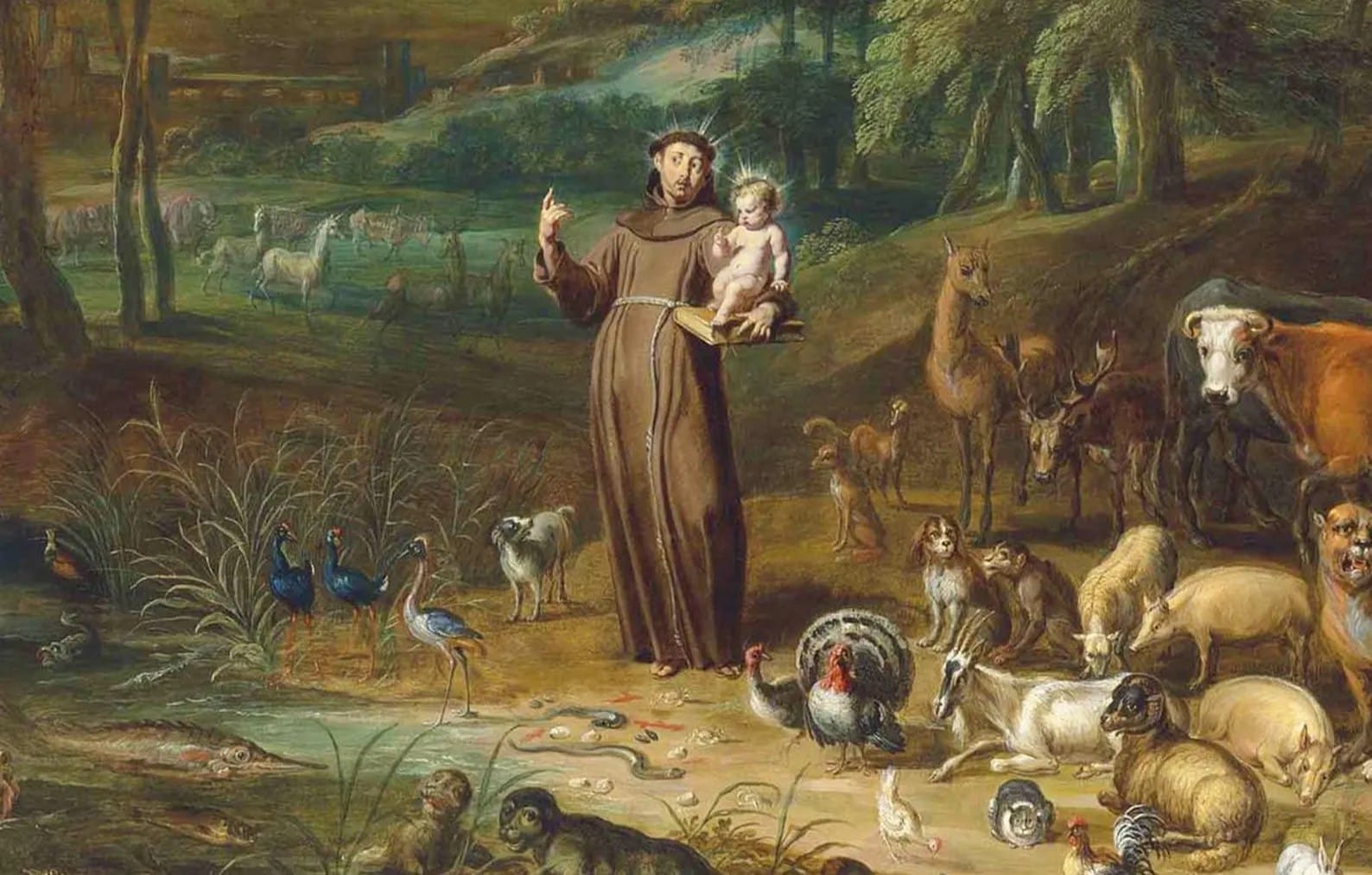
“May the Lord give you peace!” This was a favorite greeting of Saint Francis of Assisi. He said it to rich and poor alike, to soldiers and statesmen, to those who were sick and suffering, and he even said it to the birds. It’s a greeting that reflects the radical transformation that took place in his life. He even shared this greeting in a letter to a close friend while suffering from the illness that took his life on October 3rd, 1226.
We celebrate the Feast of Saint Francis of Assisi on October 4th, and the Franciscan Jubilee honoring the 800-year anniversary of his passing continues until January 10th, 2027. In life, Saint Francis sparked a renewal of faith in Christ. In the 800 years that have passed since his death, he has been a powerful intercessor, and he continues to inspire people to discover the peace of God in their lives.
In his “Saint Francis of Assisi” biography, G.K. Chesterton draws a comparison between the troubadour poets with whom Francis identified prior to his conversion and the title he gave his wandering band of ascetics, the “Jongleurs de Dieu” (“Jugglers of God”). Associating troubadours with knights and jongleurs with jesters, Chesterton writes, “The jester could be free when the knight was rigid…This parallel of the two poets or minstrels is perhaps the best preliminary and external statement of the Franciscan change of heart.”
This change of heart, Chesterton observes, is “the reason why the Franciscan, ragged, penniless, homeless and apparently hopeless, did indeed come forth singing such songs as might come from the stars of morning; and shouting, a son of God.” It was a leap that enabled Francis and his followers to empty themselves of worldly cares to arrive at a deep appreciation for God’s creation. As Chesterton writes, “The mystic who passes through the moment when there is nothing but God does in some sense behold the beginningless beginnings in which there was really nothing else.”
Arriving at this starting point, Francis was able to see God’s gift in the simplest things and the humblest of people, an outlook that has inspired saints from Clare of Assisi in his own time to one of our most recent saints, Carlo Acutis, who was so inspired by Saint Francis that the medieval Umbrian town of Assisi became his favorite pilgrimage site.
Francis, Clare, and Carlo are all buried at churches very near to each other in Assisi. Though Carlo was from Milan in northern Italy, he asked to be buried in Assisi shortly before dying of leukemia in 2006 at the age of 15. It is a testament to the enduring appeal of the detachment preached by Francis that Carlo would make this request while facing his own death.
“Transitus” is the word Franciscans use for the death of Saint Francis. It is a Latin word meaning “a passing,” “going,” or “moving through,” and it is used to refer with confidence to the time when Francis passed from this life into the next. It’s a confidence rooted in that change of heart from Troubadour to Jongleur de Dieu, when Francis started to choose to be a jester for God rather than a king on earth. He was choosing heaven even then, which is why saints like Carlo and Clare and so many others are inspired by Saint Francis of Assisi to live in appreciation for the gift of life itself, in the hope of rising together again in Christ.
For free copies of the Christopher News Note “The Seven Heavenly Virtues,” write: The Christophers, 264 West 40th Street, Room 603, New York, NY 10018; or e-mail: mail@christophers.org
Click here to subscribe to our weekly newsletter.