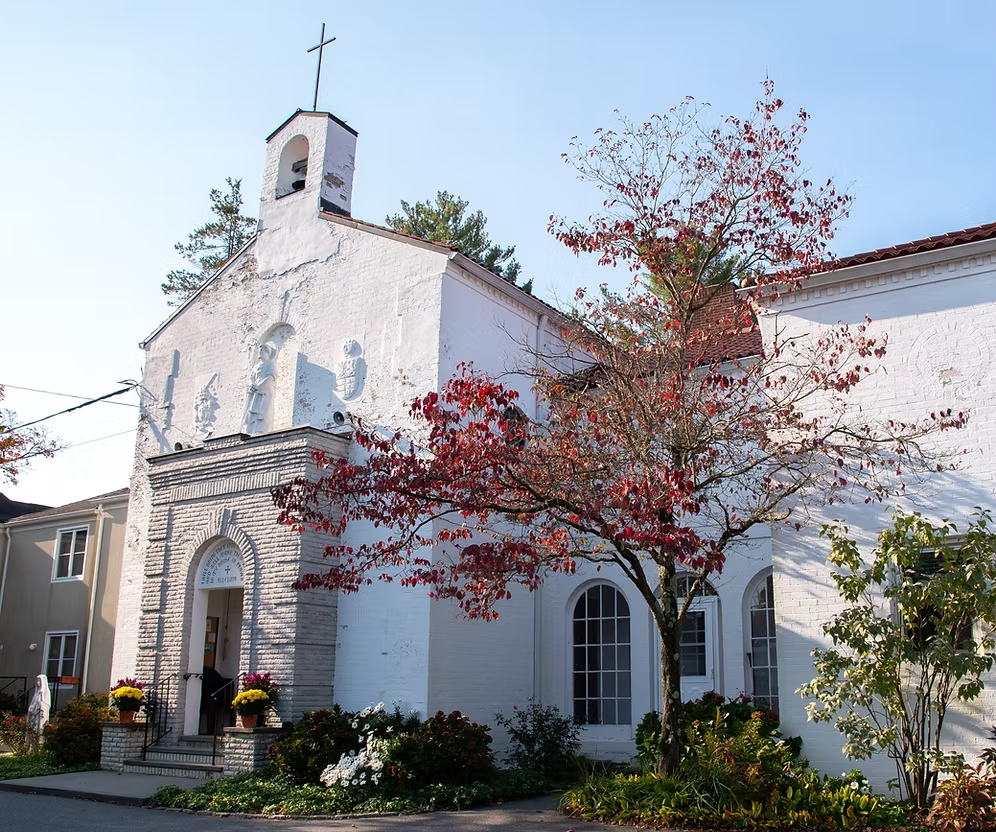
“In the very last days of 1926, a very different religious presence came to Morris County in the person of Mother Mary Magdalene of Jesus Crucified Potts, O.C.D. A native of the Washington area and the daughter of an admiral, Sister Mary Magdalene had entered the cloistered Carmelites at Philadelphia in 1911 and then had a bequest from her mother to establish a Carmel at Wheeling, West Virginia in 1913. Feeling a desire to found a Carmel ‘in poverty,’ she was looking for a site for another foundation. The desire of Bishop O’Connor to ‘do something for Our Lady’ in the waning years of his episcopate, and the invitation of a Mrs. Walsh, a woman from Morristown who belonged to a Carmelite third order group in New York City, brought Mother Mary Magdalene to Morristown. On Dec. 30, 2026, four sisters took up residence in a small house on South Street…”
— From Living Stones by Msgr. Raymond J. Kupke, pgs. 198-99
“The rest,” as we say, “is history.” When “history” concerns the Diocese of Paterson, I am always grateful to Msgr. Raymond Kupke and his wonderful book, Living Stones, written on the occasion of our Diocese’s 50th anniversary (in 1987). For those who are familiar with Living Stones, its subtitle, “A History of the Catholic Church in the Diocese of Paterson,” could be misleading and cause one to think that it “only” covers the “first 50 years,” 1937 to 1987. The first half of the book is a history of the Catholic Church in northern New Jersey from before the Revolutionary War, beginning in 1764.
So, I was not surprised when I wanted to share some background on how a Carmelite Monastery came to our Diocese (11 years before the foundation of the Diocese of Paterson); I was quickly able to find a compelling account, as cited above, on pages 198-99 of Living Stones. When I was appointed as bishop of the diocese, six years ago, I was very happy to learn that we had a Carmelite Monastery in our diocese. Like millions of others during the past 100-plus years, I was “introduced” to the Carmelites and Carmelite Spirituality when I first heard, in high school, about St. Therese of Lisieux, the “Little Flower,” and her autobiography (spiritual diary), Story of a Soul.
If you are not yet familiar with the Carmelites, their spirituality, and their saints (Therese of Lisieux, Theresa of Avila, John of the Cross, Theresa Benedicta of the Cross, St. Simon Stock, and many, many more — personally, I think that St. Pope John Paul II could be considered an “honorary” Carmelite, because his personal spirituality and vocation were so strongly influenced by the Carmelites, especially John of the Cross and Theresa of Avila), you could Google “Carmelite Saints” or any one of the above. You could also go to the website of the Carmelite Monastery in Morristown where you can learn a great deal about the sisters, their vocation and mission, including their “Vision” and “What (they) Do.”
“Through self-sacrifice, silence, penance and prayer, the Carmelite Sisters offer their very lives as a prayer to God for all humanity … The Carmelites have a rigorous schedule consisting each day of eight hours of prayer, manual labor, some recreation, as well as contemplation. They are always striving to make themselves more pleasing to God. The Carmelite Sisters adhere to strict silence so that their prayers may be more continuous.”
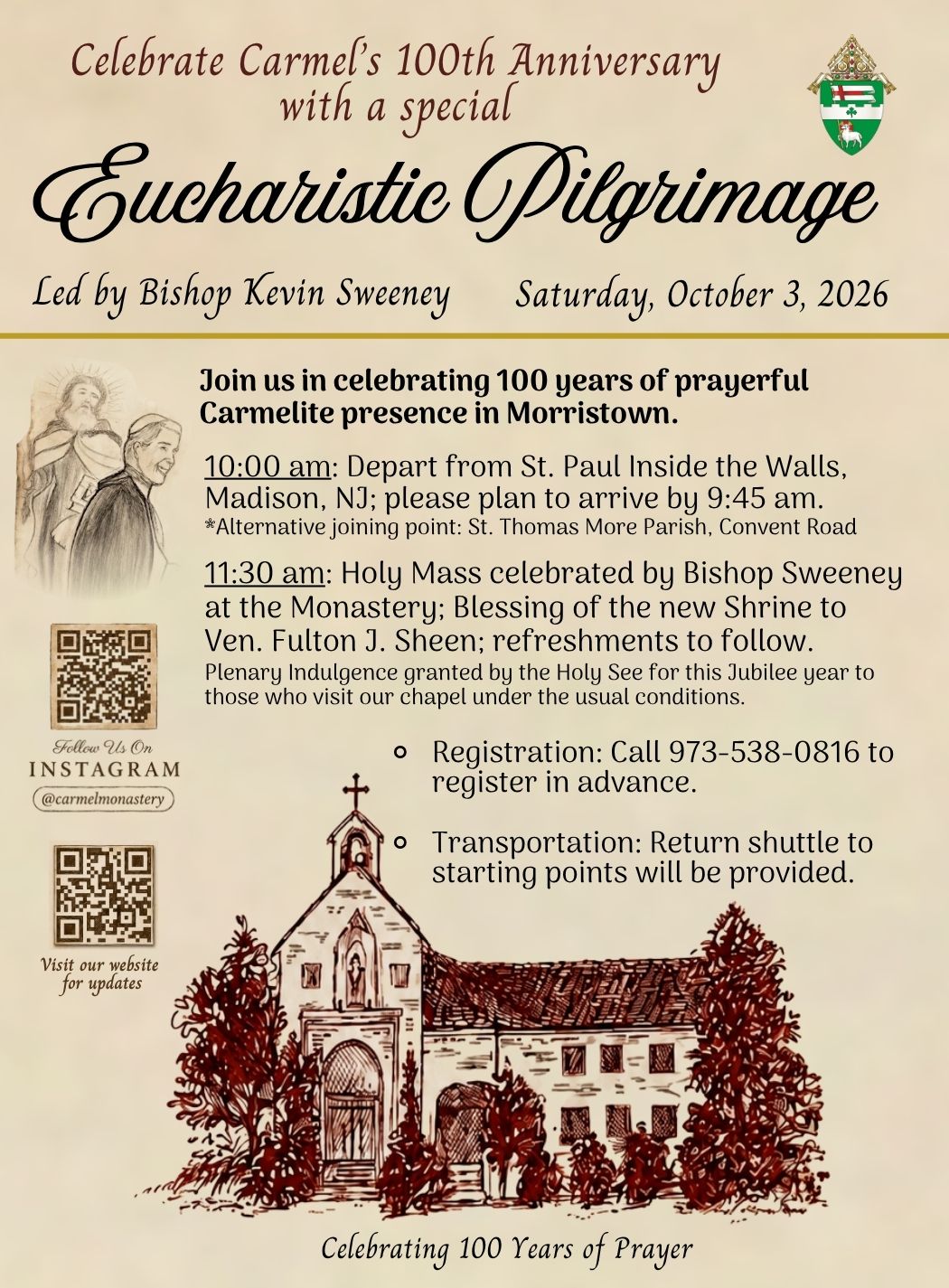
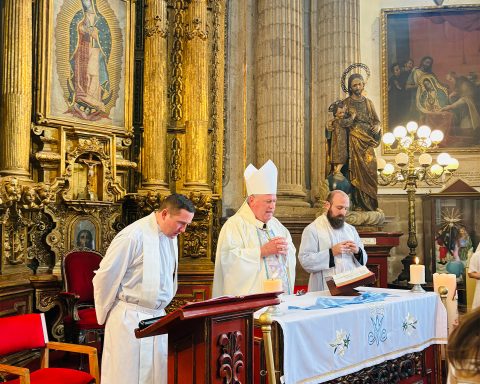
I am very much looking forward to being with the Carmelite Sisters, many of our priests, seminarians, consecrated religious, and faithful from our diocese and beyond, as we celebrate and give thanks for “100 Years” with a Eucharistic Pilgrimage and Mass on Saturday, Oct. 3, beginning at our St. Paul Inside the Wall Evangelization Center in Madison (at 10 a.m.) and concluding with Mass at the monastery at 11:30 a.m. Click here for more information and to register or see the flyer at right.
St. Therese of Lisieux died at the age of 24, on Sept. 30, 1897. She was canonized as a saint (very quickly) on May 17, 1925, during the Jubilee Year, by Pope Pius the XI. From 1927 to 1969, her feast day was celebrated on Oct. 3, before changes in the Church’s liturgical calendar, caused her Feast Day to be “moved” to Oct. 1. Personally, I find it meaningful and appropriate that we begin the month of October, the “Month of the Holy Rosary,” with the Feast of St. Therese, who in addition to being a role model for a life of prayer and contemplation, is also, along with St. Francis Xavier, the patron saint/s of missionaries, and one of only four women recognized (by St. Pope John Paul II in 1997) as a “Doctor of the Church.”
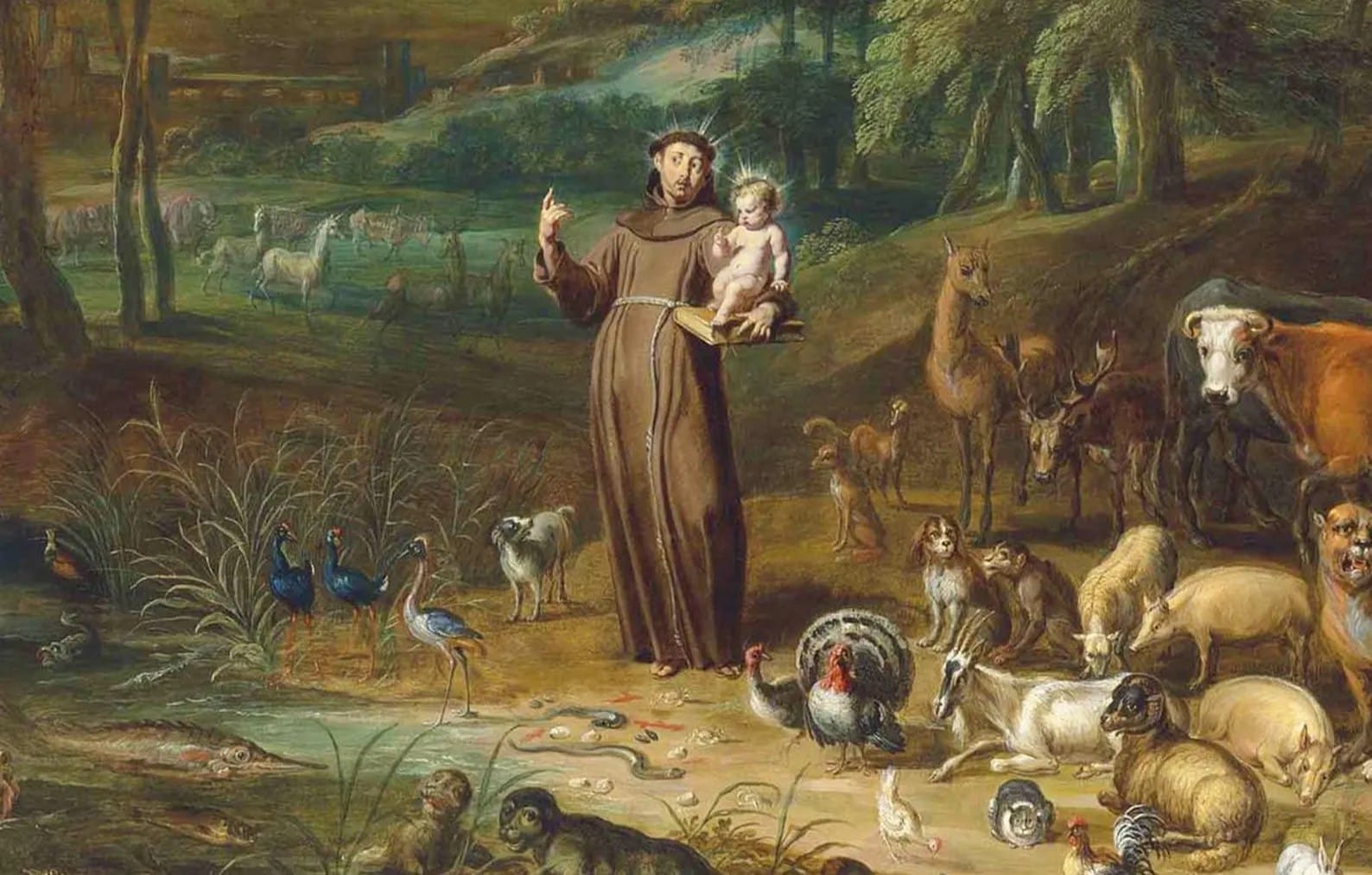
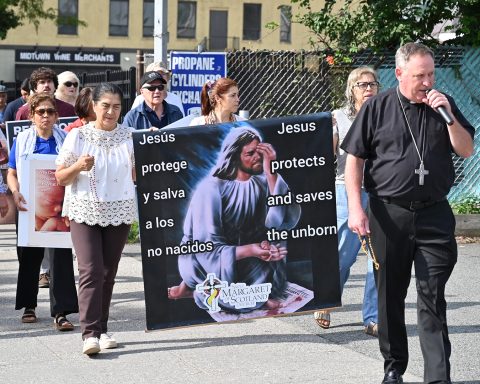
Last year, I wrote a column about the end of September and October as a beautiful (and prayerful) time of year, focusing on “The Saints of Late September and October, Respect Life Month and the Month of the Holy Rosary.” I hope that you might take the time to go back and review it. In this year of 2026, as we celebrate 100 years of the Carmel in Morristown, we are also in a “Jubilee Year of St. Francis of Assisi,” whose Feast we will remember on Sunday, Oct. 4. We will celebrate the Feast of Our Lady of the Rosary (Our Lady of Victories) on Wednesday, Oct. 7, and the next day, Thursday, Oct. 8, will be the New Jersey Mass and March for Life in Trenton.
This time of year can be beautiful and prayerful; it can also be very busy. You have probably already heard or will be hearing in the coming weeks about our annual Diocesan Ministries Appeal. We will have a very busy (full) “diocesan weekend” from Friday, Oct. 16 through Sunday, Oct. 18, when we will have our Diocesan Marian Pilgrimage to Washington, DC on Friday and Saturday, and then mark the 100th “World Mission Sunday” and host our Diocesan Vivere Christus awards on Sunday, Oct. 18. It is comforting to know that the Carmelite Sisters in Morristown will be praying for us on each step of our journey.
Celebrating this significant anniversary for the Carmel of Morristown and considering the special moments that we have to be united in prayer during the month of October, the month of the Holy Rosary, encourages us to remember that we can always unite our efforts to build up God’s Kingdom through prayer. I think of those who may be homebound, sick, or suffering. The prayers of the homebound and the ill are a source of grace for many. St. Therese, the Little Flower, spent the most significant portion of her brief life in a Carmelite monastery, but she is the co-patroness of the missions because of her commitment to pray for others. No matter where we are, our prayers are a sharing in the Lord’s work. Just as Carmel is a powerhouse of prayer, so too the prayers of those who are homebound or limited in mobility can powerfully contribute to the good of others through prayer. I thank all of the homebound, particularly, for your commitment to pray for so many worthy intentions.
Click here to subscribe to our weekly newsletter.