The doors of the Church, Pope Francis has said, must always remain open – especially for those carrying unseen wounds.
On May 2, that call took concrete shape as more than 200 clergy, religious, educators, mental health professionals, ministry leaders and more gathered with a shared purpose: confronting the growing mental health crisis not from the margins, but from the heart of the faith community.
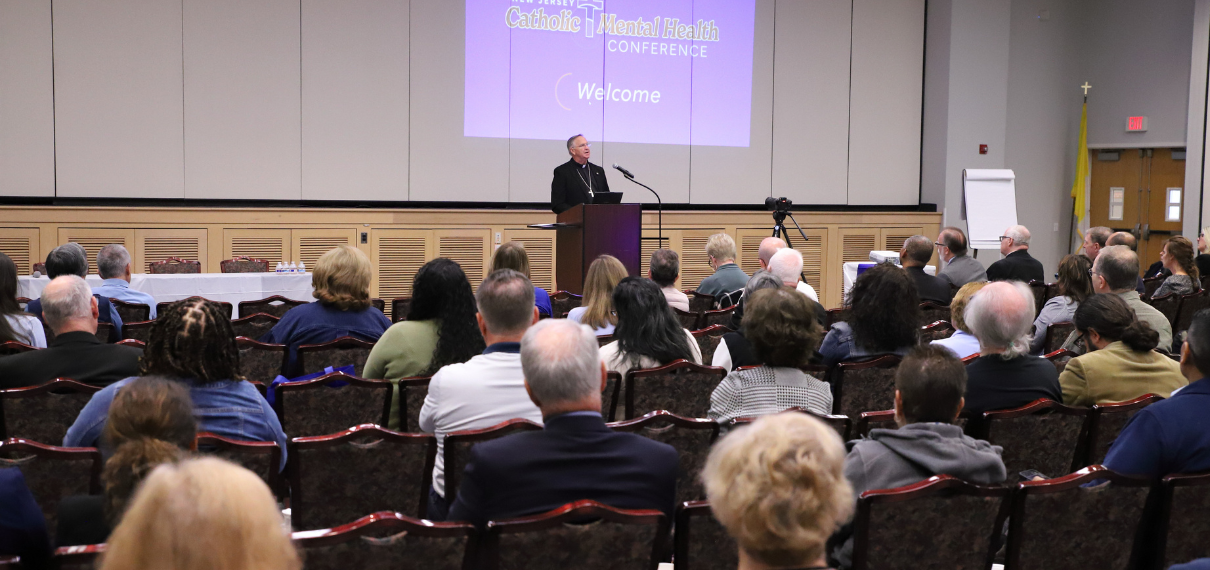
“Struggle is not a failure of humanity. Silence is. When we treat addiction or mental illness as something that must be concealed or explained away or endured alone, we unintentionally transform human suffering into spiritual isolation – and isolation is where despair grows,” said Bishop John Dolan of the Diocese of Phoenix, the keynote speaker for the New Jersey Catholic Mental Health Conference held at the St. John Neumann Pastoral Center, Piscataway.
“One of the hardest truths to face is that a person can be deeply loved but still feel completely alone,” he said. “That’s why presence matters. Not abstract care, but real encounter.”
Hosted by the Diocese of Metuchen, the conference, titled “From Isolation to Belonging: Mental Health and the Catholic Church,” brought together participants from all five New Jersey (arch)dioceses, as well as leaders from multiple religions. The daylong gathering blended pastoral reflection with practical strategy from Bishop Dolan and leading Catholic voices and experts in the field.
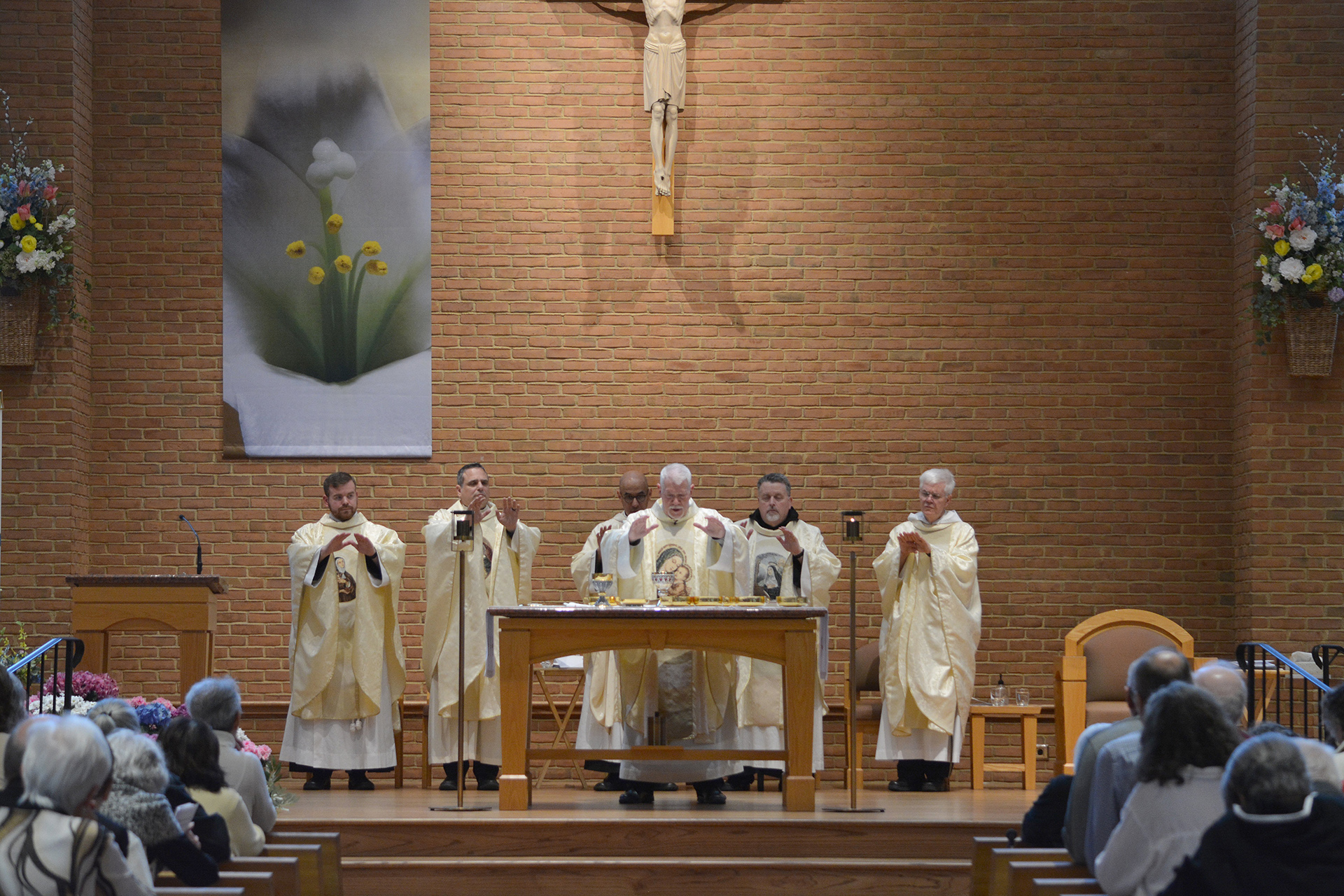
The day started with Mass celebrated by Cardinal Joseph Tobin of the Archdiocese of Newark. Concelebrating were: Bishop Joseph Williams of the Diocese of Camden; Father Jonathan S. Toborowsky, administrator of the Diocese of Metuchen; Bishop Dolan, and Father Tim Graff from the Archdiocese of Newark.
Coordinated by the New Jersey Catholic Conference in partnership with the state’s dioceses, Catholic Charities agencies and the Catholic Healthcare Partnership of New Jersey, the conference reflected a growing recognition among Church leaders: the mental health crisis is not only a clinical concern, but a pastoral one.
That message was echoed in Cardinal Tobin’s opening remarks, where he invoked Pope Francis’ vision of the Church as “a field hospital after battle.” The image, he suggested, is more than metaphor. It is a directive – one that calls the Church to move toward those who are wounded, to listen without judgment, and to build communities where isolation gives way to belonging.
Suffering in Silence
In his keynote, Bishop Dolan, a survivor of suicide loss, spoke on the effects of isolation and the importance of accompaniment. He cited a 2023 report from the U.S. Surgeon General that found how chronic loneliness can increase the risk of premature death to a level comparable to smoking up to 15 cigarettes a day. In addition, chronic loneliness can raise the risk of dementia in older adults by roughly 50%.
“One of the hardest truths to face is that a person can be deeply loved but still feel completely alone,” he said. “That’s why presence matters. Not abstract care, but real encounter.”
A person can be in a room and still be distant. One can be surrounded by people and still feel alone. To be with someone is to be present in a way that acknowledges the other and allows that person to matter. Show up. Stay. Listen.
“That is why the word ‘with’ carries such weight,” Bishop Dolan said. “It points to something deeper than proximity. It speaks of relationship. It speaks of identity.”
Being present for others is especially important in a world in which humanity is connected more than ever before, while true communication is lacking.
“I have come to say clearly: Isolation kills but communion heals. I say that because I’ve seen it and I’ve experienced it,” he said, explaining that five of his family members have died by suicide.
“There is a silence that follows this kind of loss. It’s different,” he explained. “There are questions that don’t always have answers. You find yourself wondering, ‘What more could have been done? Where did I go wrong? Why wasn’t I there? How may I have made a difference?’”
This is also true among leaders of faith, Bishop Dolan said. “I’ve met priests who waited years before seeking help, years of quiet anguish, because they feared disappointing their bishop, their community or their people. I’ve met women religious who believe their vows required endurance without expression. Endurance is not the same as holiness. Suffering in silence is not a sacrament or religious virtue.”
Hope and Healing
Accompaniment was among the first topics that Beth Hlabse, program director of the Fiat Program on Faith and Mental Health at Notre Dame University’s McGrath Institute for Church Life, discussed in her presentation.
Overcoming mental illness “is not just a matter of willpower,” she stressed, urging anyone accompanying a loved one to look at is as a “journey of working with [that person], rather than compounding the shame by saying it’s only a matter of willpower – because it’s not.”
“Remember, your role is not to diagnose,” she said. “[It is] to encounter each person according to their uniqueness, to discern their level of suffering and to ask the Lord, ‘Lord, how am I called to walk with this person? How am I called to support them in accessing a broader network of resources beyond what I and our immediate community can offer?’”
With more than one in five American adults living with a mental illness (23.4%), and more than one in 20 U.S. adults living with a serious mental illness (5.6%), she also addressed contributing factors, including illness, and biological, environmental and developmental elements.
Environmental factors aren’t just natural surroundings, she said. “It’s also social media and peer influence – things that put stress on us and increase our vulnerability to mental illness.”
When it comes to developmental factors, consider: “What was the family environment like growing up? The school and neighborhood environments … because when we’re young, we’re more susceptible to environmental influence than we are when we’re older. … Mental illness is not the result of just any one factor.”
God, she continued, is with every person in times of anxiety, depression, stress and illness, as seen when Jesus prayed in the Garden of Gethsemane. “God enters into the very depths of our suffering, so that even in times of desolation, we believe that God is there.”
“Healing is a movement from isolation toward communion, toward an experience of hope amidst hardship,” she said.
National Initiatives
Ben Wortham, vice president for Behavioral Health Integration at Catholic Charities USA, and Deacon Ed Shoener, founder of the International Association of Catholic Mental Health Ministers, presented a collaborative vision for addressing mental health during their session, “Mental Health Ministries for Our Parishes: National Initiatives and Local Action.” Their presentation emphasized that effective mental health care must extend beyond clinical treatment to include housing, community support, education, and spiritual care.
Wortham stressed that “mental health doesn’t happen in a vacuum,” underscoring the need for collaboration among mental health providers, health care systems, and the social determinants of health — including housing, income, employment, education, family and social support, community safety, and access to food and transportation.
He noted that even when people seek professional mental health care, recovery remains difficult if they return to unstable living conditions or lack essential support systems.
“Especially with the poor and vulnerable populations, we can’t talk about mental health without talking about basic needs being met,” he said, highlighting three initiatives developed through Catholic Charities USA:
- Healthy Housing Initiative — a program currently operating in five major cities that integrates mental health support with housing services, helping reduce chronic homelessness by pairing affordable housing with onsite mental health care.
- “Sister Hope” AI Mental Health Chatbox — a 24/7 faith-aligned support platform that provides coaching programs, referrals to Catholic Charities services, and expanded access for hard-to-reach populations.
- “Whole Hearted” — trauma-informed workshops and parish resources designed to integrate spirituality and religious practices with behavioral health education and mental health awareness.
Wortham encouraged attendees to stop viewing mental health as an isolated issue and instead focus on integrated care that addresses both emotional and material needs. He pointed to the importance of Medicaid expansion — noting that 10 states have yet to adopt the program — as well as increasing Medicaid reimbursement rates to help provide competitive salaries for mental health professionals. Above all, he emphasized the importance of continued collaboration among churches, health systems, and community organizations.
Local Action on the Parish Level
For Deacon Shoener, the central mission of parish mental health ministry is simple but profound: “to be a healing presence in our parishes.” His hope, he said, is that one day “the first place someone with mental health challenges would look for understanding and support is the Catholic Church.”
That vision is deeply personal for Shoener. Nearly 10 years ago, he lost his daughter, who struggled with bipolar disorder and died by suicide. Reflecting on the experience, he explained that “a mental health crisis is also a spiritual crisis,” one that must be met with the love of Christ and the promise of hope.
Deacon Shoener shared that the obituary he wrote for his daughter became an unexpected ministry of its own. More than a tribute to her life, it openly addressed the realities of mental illness and the needs of those who suffer in silence. The obituary spread widely online, reaching millions of readers and prompting tens of thousands of people around the world to contact him with their own stories. Again and again, he heard the same concern: many felt the Church offered little support to individuals experiencing mental illness or to their loved ones.
That response ultimately led Deacon Shoener to partner with Bishop Dolan in founding the International Association of Catholic Mental Health Ministers. Today, the lay association includes more than 7,000 members in over 75 countries and works to reduce stigma surrounding mental illness while equipping parish leaders with resources and support.
Click here for more photos of “Mental Health and the Catholic Church.”
“Mental illness is an illness just like all the other illnesses that doctors treat, and it needs to be understood that way,” Deacon Shoener said.
He noted that current efforts focus on integrating mental health ministry into the everyday life of the Church and normalizing conversations around mental wellness in the same way physical health concerns are addressed.
Addressing conference attendees directly, he challenged those interested in mental health ministry to consider their own willingness to be vulnerable. “Those of you who want to get involved in mental health ministry … are you ready to share your story?” he asked, stressing that trust and accompaniment often begin with personal witness.
He also pointed to three major barriers that prevent many people from seeking support within the Church: fear that clergy or parish leaders will not understand their experience, fear of judgment and stigma, and the perception that little support exists within parish communities.
Still, he encouraged participants to see their presence at the conference as a call to action. “If you are here, you are being tapped on the shoulder in some way to bring this mental health ministry to your community,” he said.
To learn more about Catholic mental health ministry resources, visit the International Association of Catholic Mental Health Ministers at https://catholicmhm.org.
Jennifer Mauro is the managing editor of the Catholic Star Herald, the newspaper for the Diocese of Camden. Mary Morrell is the editor-in-chief of The Catholic Spirit, the newspaper for the Diocese of Metuchen.
Click here to subscribe to our weekly newsletter.