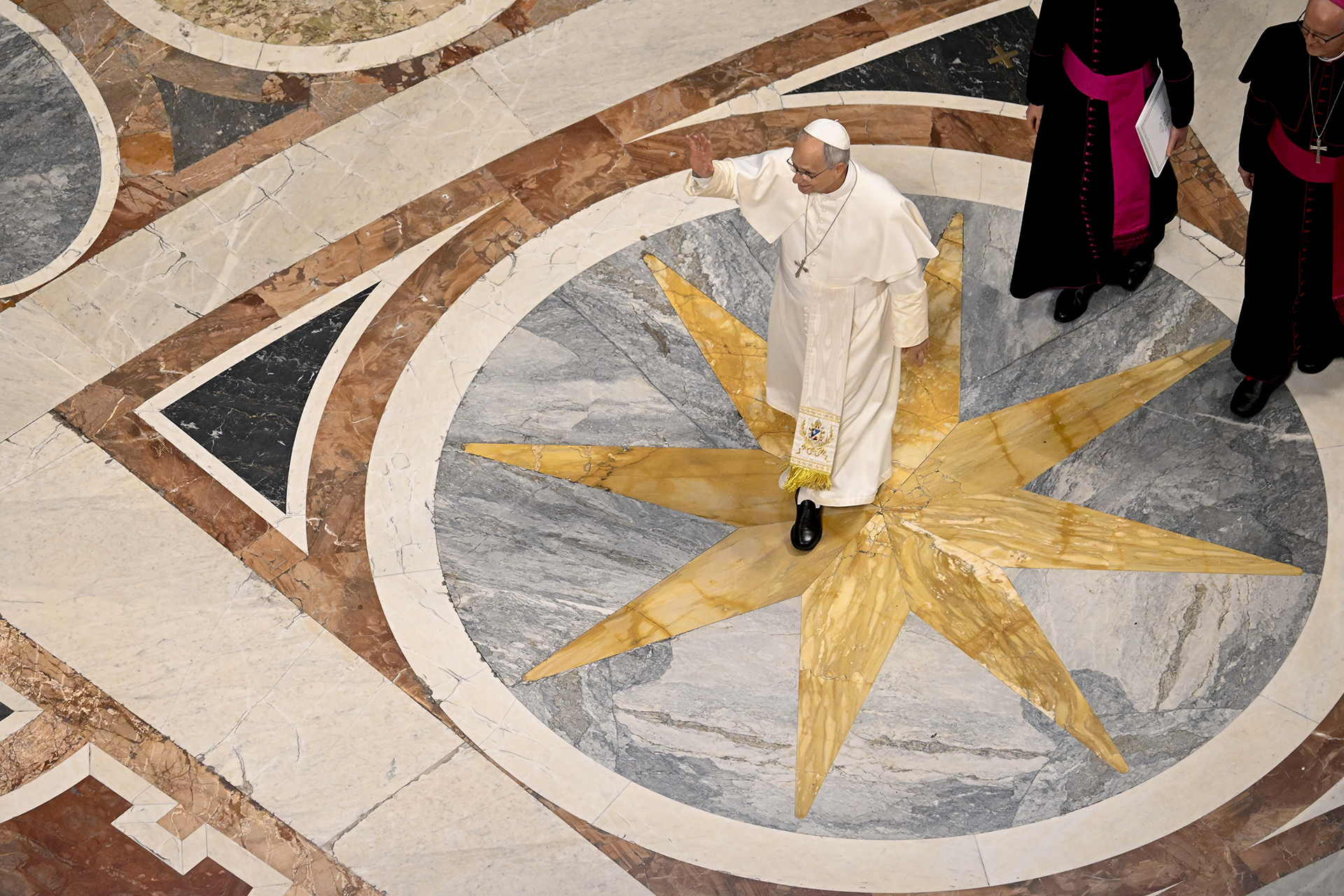
VATICAN CITY (CNS) — As wars multiply and the post-World War II international order comes under increasing strain, Pope Leo XIV has spent the opening months of his pontificate articulating a Catholic vision for international relations rooted in human dignity, international law and multilateral cooperation.
Through his speeches, diplomatic addresses and first encyclical, “Magnifica Humanitas,” the U.S. pope has consistently argued — like his predecessors — that lasting peace depends less on military strength than on politics grounded in the dignity of every person.
This clear message comes as nationalism, unilateralism and open conflict challenge the existing international order created post-World War II, during which many of the world’s superpowers focused efforts on fostering free trade, collaboration and the development of global institutions like the World Bank and United Nations.
But what has changed, scholars told Catholic News Service, is the landscape itself, as the international postwar order enters a period of profound transition. The 2026 Global Peace Index found 61 active state-based conflicts last year, the highest number since World War II ended, and concluded that global peace has deteriorated for the 12th consecutive year.
Click here to subscribe to our weekly newsletter.
In his first encyclical, Pope Leo was clear that the global institutions that encourage partnership through multilateralism are eroding.
“The institutions that were established to safeguard the concept of a common future for all peoples and a global common good appear to have been weakened,” Pope Leo wrote, arguing that the weakening of multilateral institutions has coincided with renewed conflict, distrust and what he calls a “culture of power.”
Fabio Petito, professor of religion and international affairs at the University of Sussex, told CNS July 13 that the existing system after World War II, built on U.S. leadership, multilateral institutions and international law, is fragmenting as global power shifts toward a more multipolar world.
“We are living in this moment in which this system of regulated international relations for many decades is really in trouble,” Petito said. The result, he said, has been “a return to some form of power politics,” reflected in proliferating wars, nationalism, rearmament and militarization.
Rather than proposing a detailed blueprint for a new global order, Petito said the pope is advancing Catholic principles that should guide one. Central among them are the defense of multilateralism, international law and the belief that every person possesses an inherent dignity that transcends nationality, ideology or political interest.
That vision has already become key in Vatican diplomacy. Ahead of Pope Leo’s visit to Monaco in March, Cardinal Pietro Parolin, the Vatican secretary of state, told Vatican News that “international law appears weakened and at times overshadowed by the ‘logic of power,'” warning against a return to doctrines that justify preventive war and calling small nations “natural guardians of multilateralism.”
The same ideas also run throughout Pope Leo’s own writings.
Scott Appleby, founding dean of the Keough School of Global Affairs at the University of Notre Dame, told CNS July 21 that the pope’s international vision is rooted in St. Augustine’s distinction between the City of God and the City of Man. Throughout “Magnifica Humanitas,” Pope Leo invokes St. Augustine’s contrast between societies ordered toward power and those ordered toward the common good, which becomes a choice between a “culture of power” and a “civilization of love.”
That framework, Appleby argued, serves as the organizing principle of “Magnifica Humanitas,” explaining the pope’s criticism of nationalism, militarization, economic exploitation and the erosion of international law.
“The project for a civilization of love, therefore, must undertake the task of transforming this imposed interdependence into a willed and chosen solidarity,” Pope Leo wrote in his encyclical.
The pope’s repeated references to a “civilization of love” – a concept first expressed by Pope Paul VI – are not simply spiritual language but the organizing principle of his international thought, Appleby said. He said Pope Leo’s writings suggest that he rejects the assumption that nations are destined to pursue power at one another’s expense. Instead, the pope argues that political communities can be ordered toward the common good when they recognize the inherent dignity of every person and place dialogue, justice and solidarity above coercion.
“Those are the hooks to hang everything on,” Appleby said.
Appleby said the pope’s vision is also deeply rooted in the Second Vatican Council, which reoriented the Catholic Church’s relationship with the modern world by emphasizing the inherent dignity of every person, regardless of their religion.
“For him, it’s a period of great flourishing of religious freedom, pluralism, the Church itself becoming more global,” Appleby said of the U.S. pope.
Petito and Appleby said the pope does not seek a return to the post-Cold War world but believes it squandered an opportunity to build political institutions capable of sustaining solidarity. In “Magnifica Humanitas,” Pope Leo criticizes the “almost blind faith” placed in markets after 1989, writing that the world is now “regressing from the significant turning point of the twentieth century.”
“What the world failed to do is create political structures capable of supporting a civilization of love,” Appleby said. “Instead, markets became the end-all and be-all of the new world order,” contributing to today’s crises of nationalism, weakened international institutions and renewed conflict.
The pope also repeatedly rejects unilateralism. Whether speaking about migration, war or governance, he argues that modern crises cannot be solved by individual states acting alone.
“No nation can face a challenge of this magnitude on its own,” Pope Leo told the Spanish Parliament at the Congress of the Deputies in Madrid June 8. “Therefore, a coordinated, supportive, and effective response is indispensable.”
Throughout his speeches, he argues that diplomacy, international law and multilateral cooperation depend on recognizing the dignity of every person.
“Peace is not something we must invent: it is something we must embrace by accepting our neighbor as our brother and as our sister,” the pope told community members in Bamenda, Cameroon, April 16, 2026.
Speaking at a June 22 seminar at Rome’s Pontifical Gregorian University, Massimo Faggioli, professor in the Department of Theology and Religious Studies at Villanova University, said the Vatican’s diplomatic importance has increased precisely because traditional alliances are becoming less stable, calling the Vatican “one of the last visible guardians of multilateralism.”
Faggioli argued in his talk that growing tensions between Europe and the United States have elevated the Vatican’s diplomatic importance. Describing the U.S.-European alliance as once “a turbulent marriage,” he said it is now unclear whether that relationship still exists.
He said that it is in this context that the Vatican is “one of those voices that advocate or help neutral bridges for reconciliation,” leading to a period he believes could be “Pax Vaticana.”
Jodok Troy is an assistant professor at the Department of Political Science at the University of Innsbruck, Austria. He told CNS July 20 that the Holy See has always promoted multilateralism and this idea of an international world order through diplomacy. But in an increasingly conflicted world, he said, the papacy has gotten louder.
“The argument of the popes always has been: we need to make sure of this multilateral order, because it’s not something that is self-sustaining,” Troy said. “It’s not something that runs by itself. It requires consistent work.”
The scholars also agreed Pope Leo is building on his predecessors’ appeals and Pope Francis’ unique legacy rather than departing from them.
“Pope Francis broke new ground,” Faggioli said. “I don’t see Pope Leo retreating from that ground.”
Petito added that while Pope Francis often led through symbolic gestures, Pope Leo has shown greater interest in strengthening institutions.
As Pope Leo continues to appoint more leaders from the Global South to senior Vatican positions, he is also strengthening ties to the regions where the Church’s presence is growing fastest.
In many of those countries, the Catholic Church serves not only as a religious institution but also as a trusted civic actor, with bishops frequently mediating conflicts, monitoring elections and advocating for democratic processes. That combination of demographic growth and public credibility could give the Holy See an increasingly important role in international affairs at a time when many state institutions are under strain.
Troy said the pope’s emphasis on the Global South reflects more than a changing demographic makeup of the Church. Many of tomorrow’s geopolitical challenges, he said, will emerge in regions where state institutions are weak but where the Catholic Church remains one of the few enduring social institutions, providing education, humanitarian assistance and moral authority.
“As political institutions become weaker,” Troy said, “the Church will have an increasingly important role to play.”